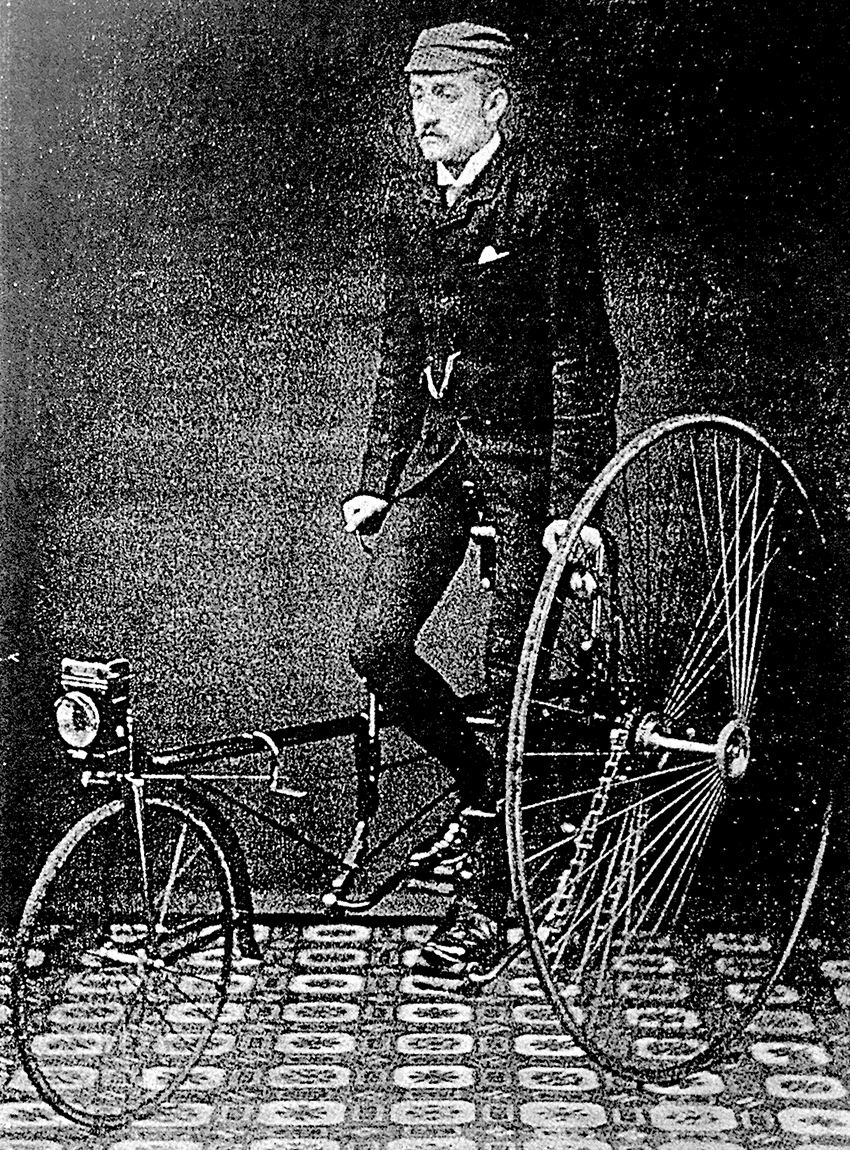
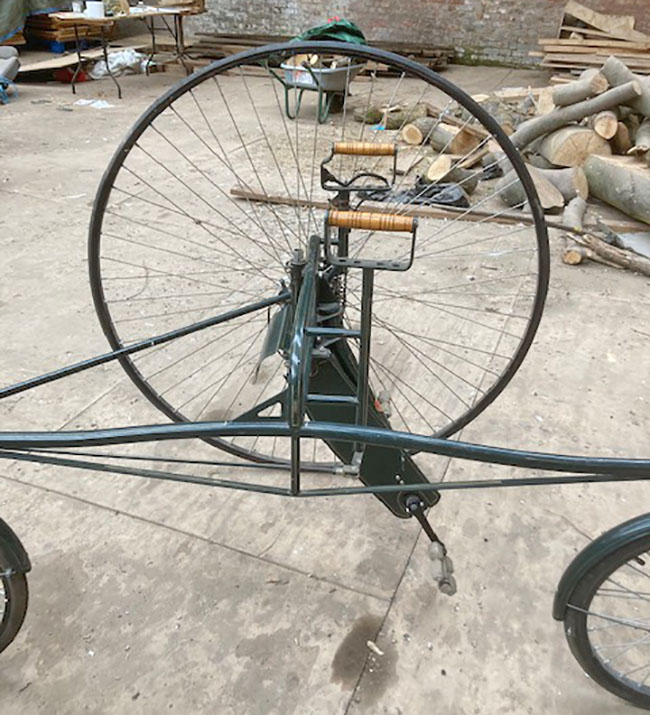
The men and companies involved with the Coventry Rotary tricycle were some of the leading pioneers of bicycle invention and production.

JAMES STARLEY – considered the ‘father of the bicycle’. He left Coventry Machinists Co in 1870 and, with William Hillman (who went on to found Hillman & Herbert, makers of the ‘Premier’ bicycle, and, later, Hillman Motor Co), set up their own business. In 1876 James Starley patented the ‘Coventry Lever’ Tricycle (patent No. 4478/1876) as depicted on the Starley Memorial in Coventry. The ‘lever’ tricycle had evolved from Starley’s first lady’s bicycle, a lever-driven “ordinary” with wheels out of track.
Haynes & Jefferis were two former foremen of James Starley at Smith Starley & Co. and they took up the licence from 1875 to produce James Starley’s bicycles. The ‘Coventry Tricycle’ was patented in 1876 and produced from 1877, including production under licence by Haynes & Jefferis. On the left was a wheel of 50 in. and on the right two 20 in. wheels connected by a long tube, both of which were steered by a handle. A version was produced with two riders sitting back to back but it never became popular.
JOHN KEMP STARLEY: (1854-1901) was James Starley’s nephew. He was the son of John Starley (who was the elder brother of James Starley). J.K Starley worked with Haynes & Jefferis, but left to form his own firm in 1878. Initially he was the sole proprietor but he was joined shortly after in 1879 by William Sutton, who had previously been working in haberdashery in Coventry. George Franks, a retired diamond merchant, became associated with the business and it was he who suggested the name ‘Rover’. The first ‘Starley & Sutton’ premises were at St John’s Works, Fleet Street.
GEORGE WOODOCK: was a Coventry solicitor and investor. When the Haynes & Jefferis firm collapsed, he bought the assets, along with those of the by now failed ‘Starley & Sutton’ firm. In November 1879 he amalgamated the business with the ‘Tangent and Coventry Tricycle Co’ under the management of Messrs Coppen and Lawson.
HARRY LAWSON: is credited as being the inventor of the safety bicycle with his 1876 and 1879 designs. His premises were at Regent Iron Works, North Road, Brighton, but he joined ‘Tangent and Coventry Tricycle Co’ as a manager. He left to form his own company in 1881 (National Bicycle & Tricycle Co). Lawson was considered a maverick by the established figures of the cycle industry: his early safety bicycle designs enabled him to register patents, but were not considered functional by BSA, who he employed to build a later version.
Harry Lawson updated the ‘Coventry Tricycle’ with a rotary action and chain drive, using his patent No. 972/1877. When chain drive was fitted to this type of tricycle, James Starley stated that the new system of driving was not intended to supersede the older lever action, but was introduced to suit those riders who preferred the rotary motion of the feet. So this modified machine became known as the ‘Coventry Rotary Tricycle’, with the earlier Starley version now described as the ‘Coventry Lever Tricycle’. It later became known as the ‘Rudge Rotary’.
THE ‘TANGENT & COVENTRY TRICYCLE CO’ – with premises at Spon Street, Coventry, this company was established in 1878 by George Woodcock. It comprised the assets of Haynes & Jefferis and ‘Starley & Sutton’.
DAN RUDGE: was another well-known pioneer of the cycle industry. He died in 1880 and his company ‘D. Rudge & Co’ was acquired by George Woodcock. It was merged with the ‘Tangent and Coventry Tricycle Co’ to form a new company ‘Rudge Cycle Co.’ He relocated the combined business to Ariel Works, Trafalgar Street, Coventry.