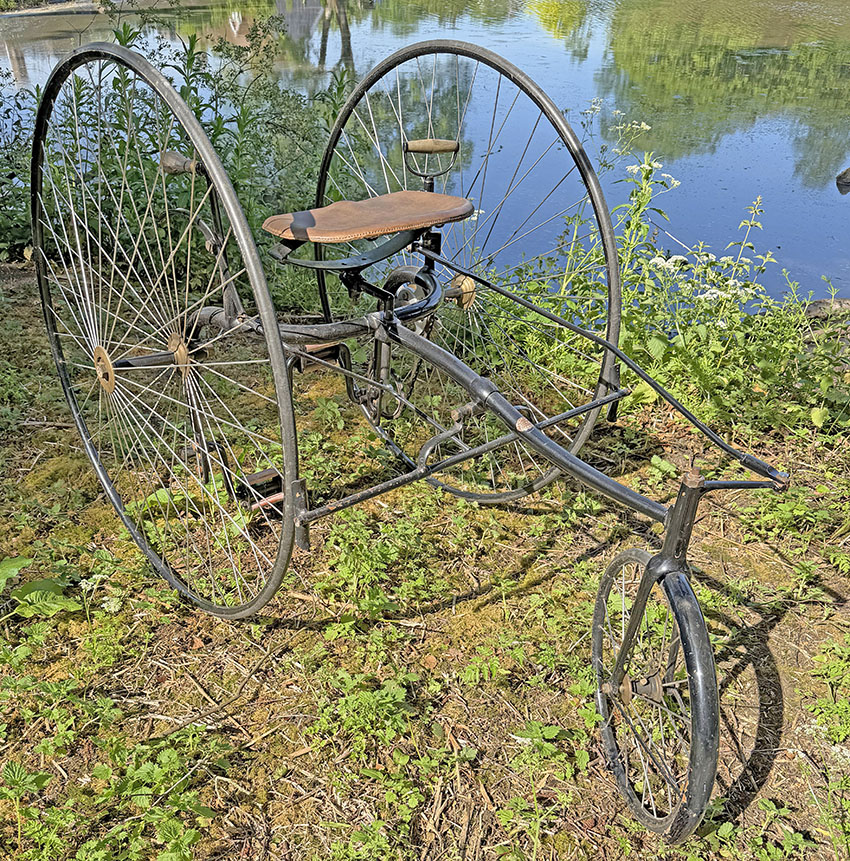
Manufactured by William Spiers of Queen St Works, Leicester
40″ Rear wheels
19″ Front wheel
LENGTH: 69″
WIDTH: 35″
HEIGHT: 40″
This is the only surviving example of William Spiers ‘Leicester Defiance’ rear-steering tricycle. It was restored many years ago and it is still in superb condition. It surprised me how easy it is to ride and it felt very stable and responsive while cornering. Although it’s 142 years old, it’s easier to ride than a modern tricycle!
This would be an excellent machine to display so you can explain the development of the first tricycles, and it would also be an ideal candidate for riding in veteran cycle events.
BRAKE & REAR-STEERING
SEE ME RIDING IT ON YOUTUBE
WILLIAM SPIERS
Queens Street Works, Leicester
In the late 19th century, Leicester was a centre of the bicycle making industry. There was Barron of Albion Street, Clay of Belgrave Gate, Curry of Painter Street, Davis of St James Street, Edlin of Frog Island, Fox of New Bridge, and Spiers of Queen Street.
William Spiers left school at age 9 and subsequently entered the cycle industry, making the ‘Leicester Defiance’ and ‘Spiers’ high-wheelers in 1881 at 5 St James Street, Leicester, subsequently moving to Queen Street Works, Leicester, in 1884, where he also built a ‘Leicester Defiance’ tricycle.
After giving up making cycles and tricycles, he concentrated on to making automatic circular knitting machines for coats, shirts, stockings and socks. By 1914, as machine makers and ironfounders, he had 250 employees. The knitting machine business was acquired by Wildt & Co in 1935.
1895 No. 20915 November 5
Improvements in or relating to knitting machines
We, William Spiers and Thomas Scott Grieve of Queen Street Works, Leicester, Hosiery machinists (relates to stockings, 3 pages of engineering drawings are included in the file.)
EARLY TRICYCLE HISTORY
High wheel ‘Ordinaries’ (penny farthings) dominated cycling throughout the 1870s, but they were not suitable for lady riders. As a result, tricycles were developed so that a lady could mount from the front, thereby keeping both her dress dry and her modesty intact. These big wheel tricycles were very expensive and only really suitable for city use, as a tricycle’s middle wheel did not fare well on the rutted roads of the countryside.
It was not considered acceptable for women to ride until Queen Victoria purchased two tricycles in 1881. This had a major impact on the sale of tricycles, and within a few years society ladies were riding their tricycles through Hyde Park to meet for tea on Sundays.
‘Big wheel’ tricycles were designed with the third, smaller wheel either in front or behind. The steering was controlled by a handle and an eccentric axle turned the wheels. In the case of the tricycle featured here, the axle is connected to a sprocket and chain to turn the wheel. It’s interesting to consider how this arrangement would have influenced the idea of sprocket and chain for ‘safety’ bicycles in the early 1880s.
The earlier models of tricycle were ‘rear-steerers’ or ‘open tricycles’ with the two large wheels alongside the rider and the third smaller wheel behind. Steering operated on a tiller principle, similar to the steering in a boat. You can see a variety of rear-steering tricycles below…