
John Nevil Maskelyne was an English stage magician and inventor of the pay toilet, along with other Victorian-era devices, and many of his illusions are still performed today. Psycho is his best known contrivance. He conceived it with his fellow inventor John Algernon Clarke. It was a mechanical puppet designed to play hands of the card games Whist and Nap. The plinth that Psycho sits on is too small for a man or even a child to fit inside. Psycho performed on top of a transparent glass cylinder which further baffled audiences by proving that Psycho was not controlled by wires or human hands.
The exact workings of this mechanism are unclear, though Psycho was probably operated by using bellows to push compressed air through the glass cylinder up into the plinth beneath the puppet. Reciprocal bellows would have moved the internal mechanism controlling Psycho’s hand to select the appropriate playing cards. Hidden backstage would have been the operator, Maskelyne’s stage partner George Cooke, who could see Psycho’s cards from the wings. Another of Psycho’s tricks was to smoke a cigarette through a holder. He could also nod or shake his head to answer questions from Maskelyne or a member of the audience.
Maskelyne debuted the Psycho illusion with Cooke at ‘England’s Home of Mystery’ the Egyptian Hall at Piccadilly in January 1875. Hugely popular with audiences, Psycho created a considerable buzz in the media as commentators debated how the illusion worked. Psycho appeared in over 4000 performances at the Egyptian Hall before going into retirement. He made a final appearance at St George’s Hall, Langham Place, in 1910. He was donated to the London Museum by the Maskelyne family in 1934.
– The London Museum

1889/1890 Psycho Combination Safety
Starley Bros, St Johns Works, Coventry
18″ Frame
30″ Wheels with solid tyres

I bought this rare machine from the Farren Collection in Australia. Paul Farren had obtained it in the 1970s from Tim Palmer’s museum in Tasmania. I assume it had been exported to Australia in the early 1890s when it was normal practice for British companies to sell their out-of-date models at cheaper prices abroad.
Starley Bros was James Starley’s own company, which became Coventry’s biggest cycle manufacturer for a time. A high volume of their bicycles were exported, so few have survived in Britain. Meanwhile, JK Starley (cousin of Big Bill and John who ran Starley Bros) had a much bigger advertising budget for his Rovers, a very good publicity machine, and they built top quality bicycles. So JK Starley & Co and the Rover overshadowed Starley Bros and the Psycho, and James Starley’s name is nowadays only associated with the Rover, not with the products of his own cycle company.
The Psycho is in excellent original condition and rides well. It’s not for sale.


THE PSYCHO
Starley Bros, St Johns Works, Coventry

James Starley left Coventry Machinists’ Co on 27 January, 1871, to form his own company, Starley Bros with his sons James, John and William. James Starley senior died in 1881, and his son William – known as Big Bill – soon became the driving force behind the company. It subsequently became Coventry’s largest cycle firm, and they claimed to have first exhibited a diamond frame safety at the Stanley Show in February 1886, though the top tube was a bracing strut rather than a fixed tube.
Dan Albone is credited with inventing the first ladies’ bicycle in 1887, and the first Starley Bros ladies bicycle was introduced the following year, as The Psycho (above). It’s believed that the name Psycho was “inspired by an automaton of that name demonstrated by Maskelyne at The Egyptian Hall, a figure which, among other feats, could play a hand of whist.” (see top of the page).
The Psycho had a removable top tube to make it suitable for a gentleman to ride, and to provide added strength to what was essentially a weak design. Over the next few years, the other leading companies brought out their own ladies’ bicycles using a similar design. From 1889 onwards, a small curved brace was added above the bottom bracket to strengthen the single tube when the machines were used as a ladies’ bicycle without the top tube. I’ve not yet found an illustration of the Psycho with this additional brace. If you compare the illustrations above and below you can see that the other difference between the 1888 model and the 1889 (or later) model is the wheelbase. The first model was shorter, similar to the first crossframe safeties, while subsequent models reflected the size of the gentlemen’s machines that were by now appearing.
The Psycho became the top selling machine of this style because it was taken up by American companies who had not yet started building their own bicycles and so depended on importing English machines. Typically, it was older models that the English manufacturers sold for export, as at home the market was changing so rapidly (because of constant innovation) that the leading companies had to bring out new catalogues two or three times a year to include their new designs.
The style of bicycle with a removable top tube was known as a Convertible in Britain and a Combination in the US. I’m not sure if the example featured here should be called a Convertible or a Combination, as it was found in Australia, which was another important export market for Starley & Co


THE PSYCHO ADVERTISED IN IN AMERICA


1892 BIDWELL CATALOGUE EXTRACTS
Bidwell sold the Psycho in the USA as the ‘Ladies Psycho’ without the removable top tube and the ‘Ladies Student’ as the Combination version. They no longer had open steering, suggesting they were still being supplied by Starley Bros rather than built by Bidwell.


EVOLUTION OF THE LADY’S BICYCLE
The following article was written in 1906, showing ladies’ safeties from Ivel’s 1887 model onwards. I’ve added examples of ladies’ safeties that used a single tube between 1887 to 1895. Some were illustrated with the extra brace above the bottom bracket or the removable top tube, like this Psycho. It’s a logical assumption that these options would have been added if the models were carried on beyond their first year of production.


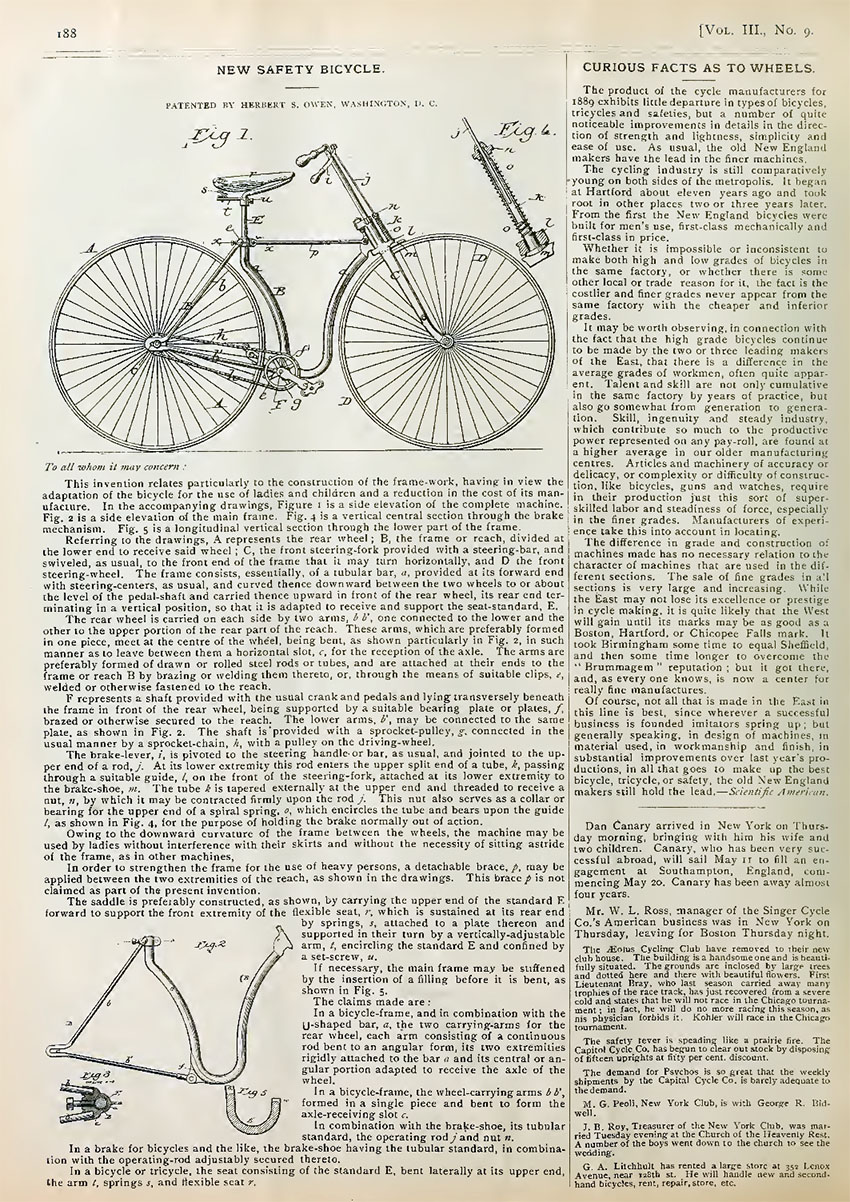
1889 LADIES’ SAFETY PATENT (S. OWEN, USA)
1889 SWIFT LADIES SAFETY

1889 RIVAL LADIES SAFETY

1889 RIVAL & IVEL SAFETY

1889 LADIES’ ROVER

1890 LADIES’ ROVER

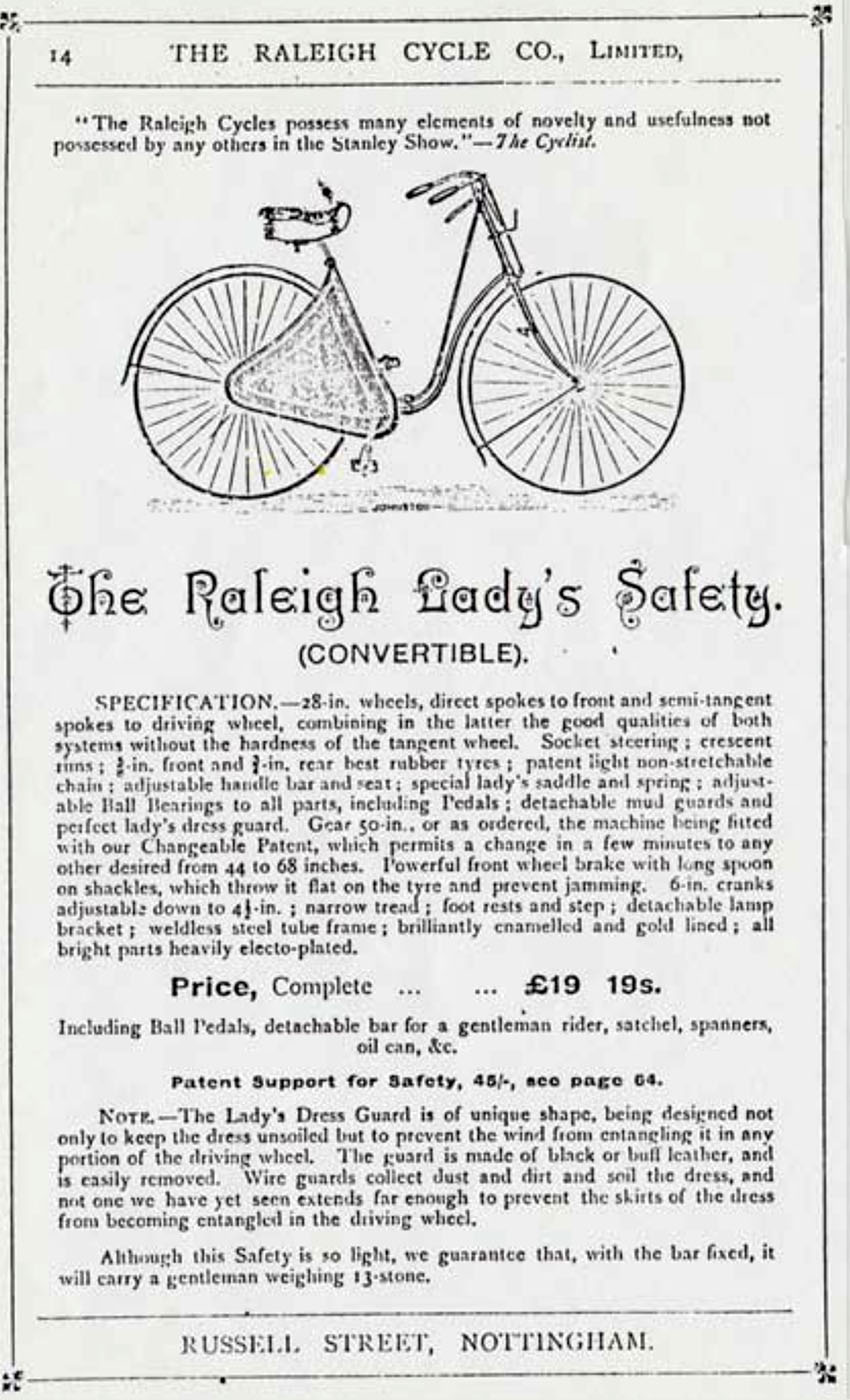
1890 RALEIGH LADIES SAFETY
1890 REFEREE LADIES SAFETY

1891 IVEL LADIES SAFETY

1891 AMERICAN LADIES SAFETIES

1891 LOVELL DIAMOND

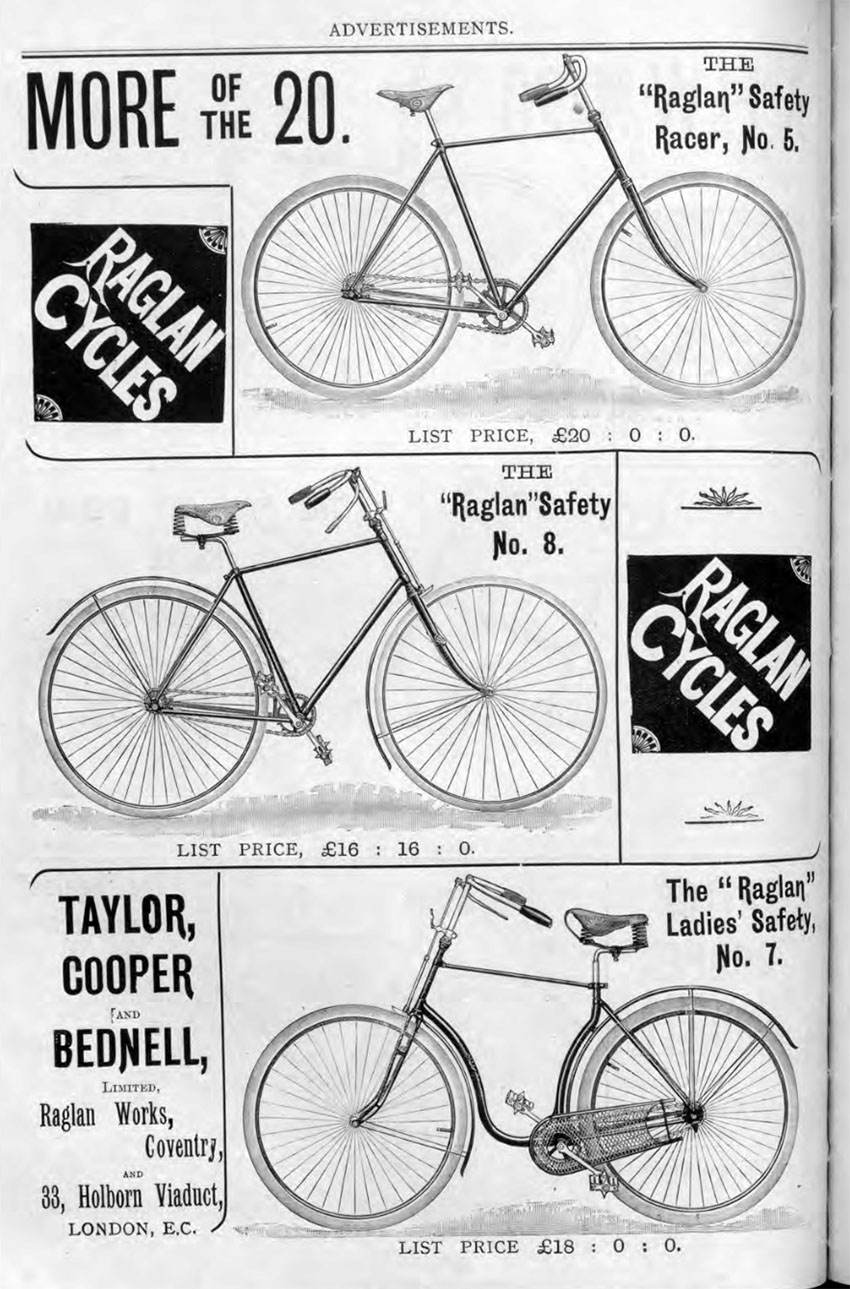
1892 RAGLAN LADIES SAFETY
1892 TOWNEND LADIES SAFETY

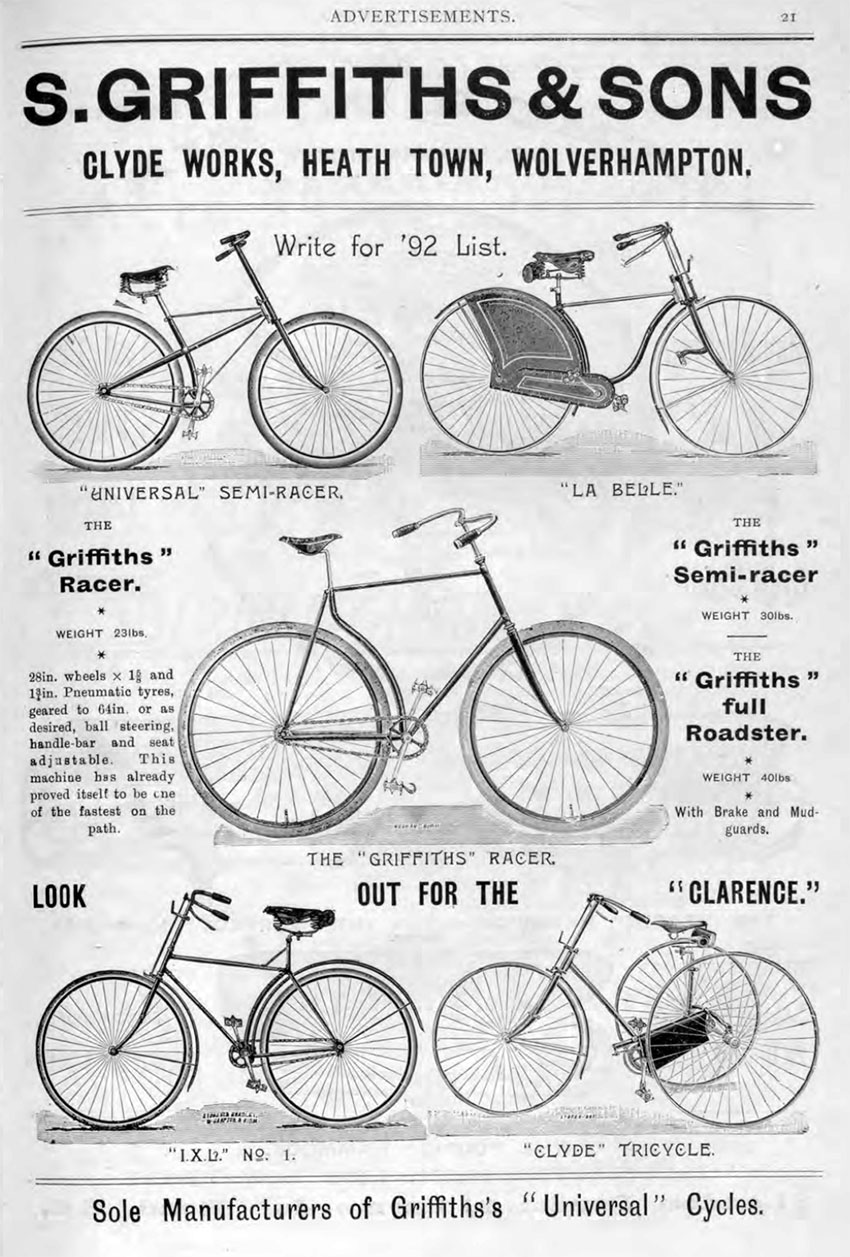
1892 GRIFFITHS ‘LA BELLE’
1892 CENTAUR ‘QUEEN OF SCORCHERS’
This Centaur Ladies Safety has an amusing name …Queen of Scorchers. It’s amusing because these ladies’ bicycles were built with a dropped frame in order to accommodate ladies’ full skirts. Even if the rider’s legs were strong, it was not easy to ride fast, especially wearing a dress. And, worse still, because the frame had only a single tube, it was inherently weak. Centaur also described it as a ‘fairy light mount’ and ‘the lightest safety on the market.’ In my opinion this was a recipe for disaster.
SCORCHERS: Both ladies and gentlemen were expected to sit upright on their saddles, and if a rider of a safety bicycle adopted a forward-leaning position (as used by racing cyclists) they were described as a ‘scorcher’ which was a derogatory term suggesting an uncouth person.
Of course, these days we might not worry unduly about being uncouth, but, in Victorian society, etiquette was paramount. Note also that the conventions and restrictions applied in western society in the 1800s are only slowly disappearing in some parts of the world. Even now there are parts of the world where women are ostracized for riding a bicycle.


Screenshot
1892-1895 STARLEY BROS SINGLE TUBE LADIES MODEL

1895 ROVER LADIES SAFETY
This 1895 Rover would appear to be the last of the ladies’ bicycles built in this ‘single tube’ style in Britain. As you can see, the single tube has a curved strengthening brace above the bottom bracket similar to the Psycho. As the design was still being used in 1895 – at least by Rover who only built top quality machines – I assume that was sufficient to stop the single tube breaking. But it was nevertheless an outdated design by then, and that same year saw the introduction of Rover’s new styles of ladies’ bicycles. If you follow the link onto the 1895 Rover’s page, there will be an additional link to that new Rover design.

TO SEE THE
1895 ROVER LADIES SAFETY
PLEASE CLICK HERE
