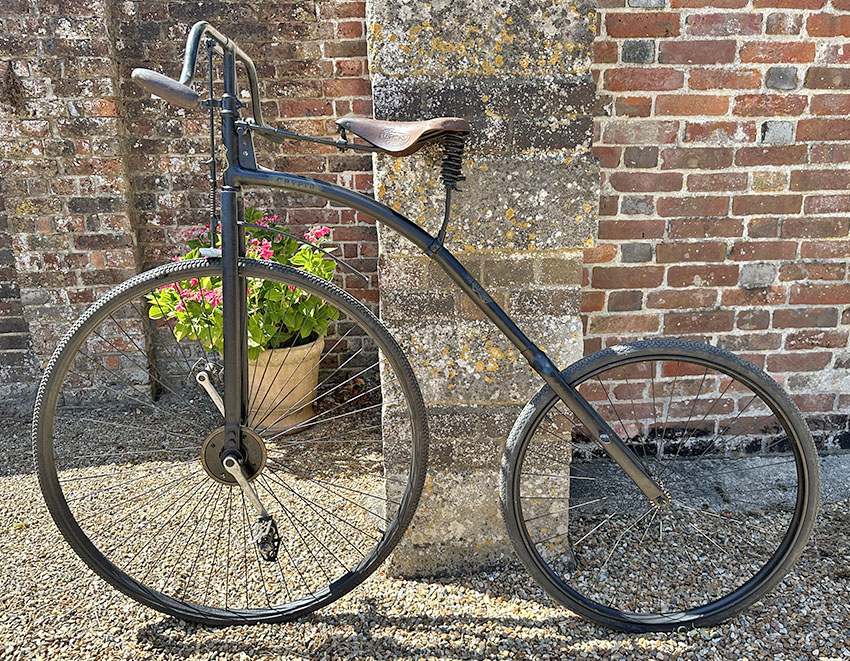
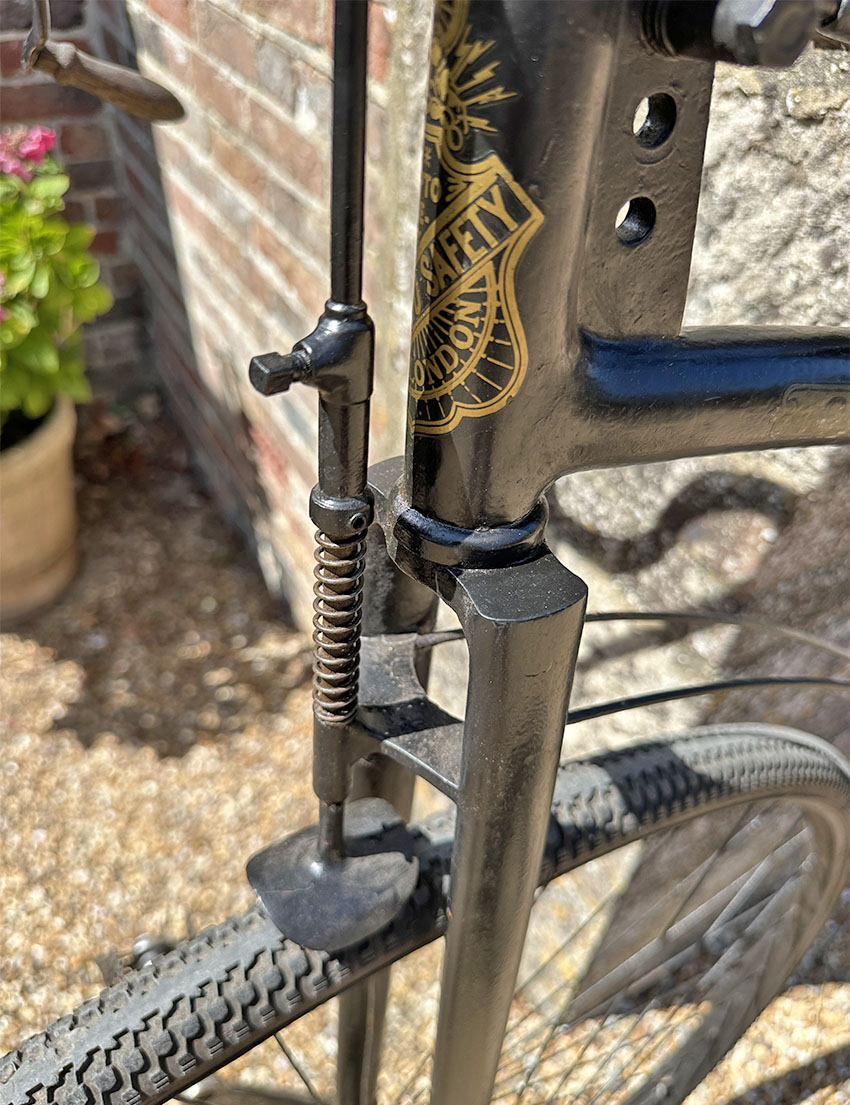
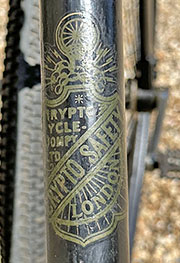
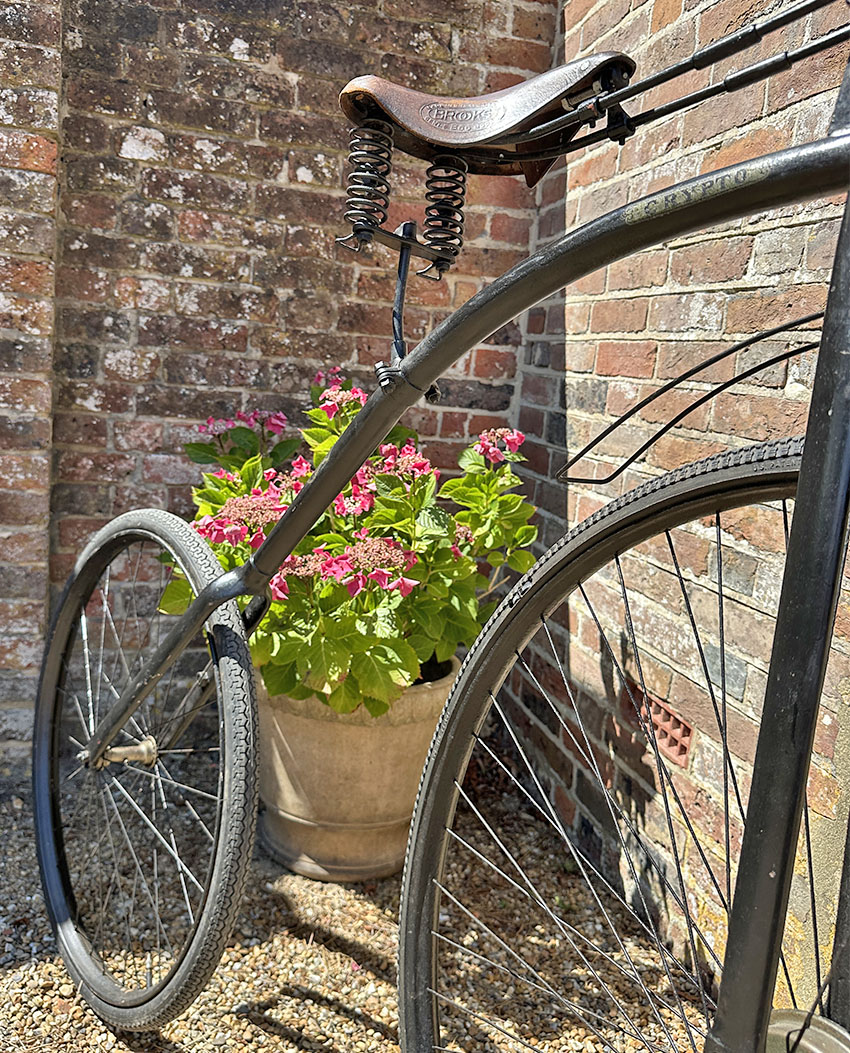
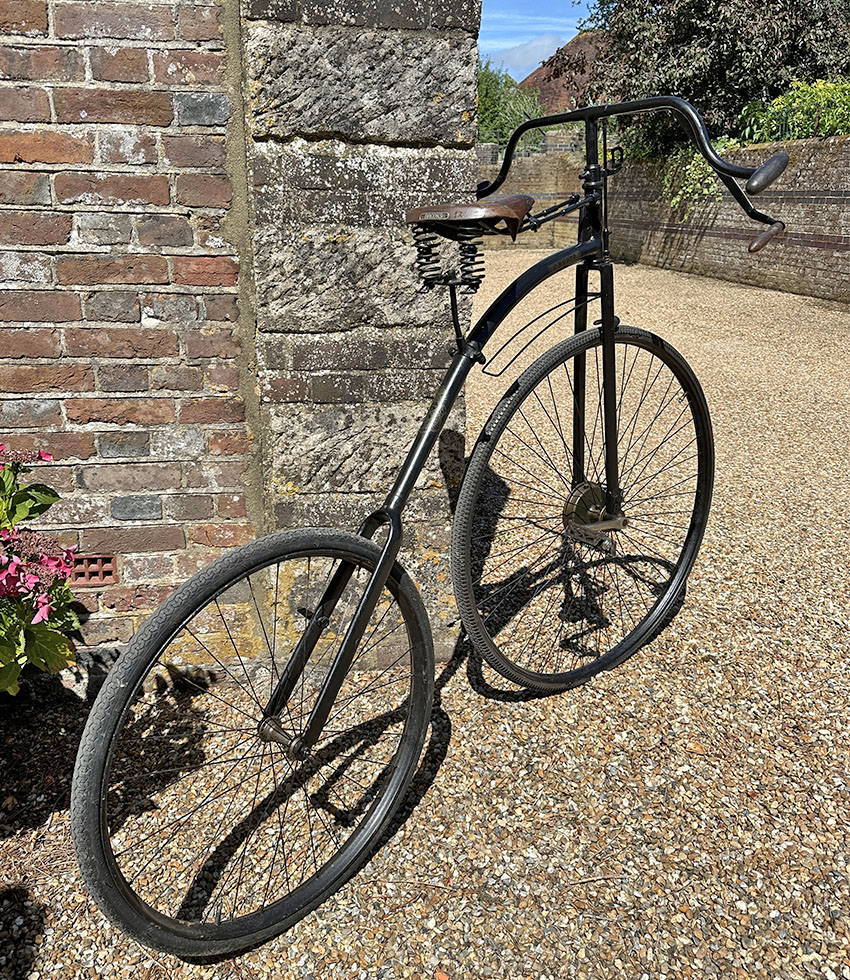
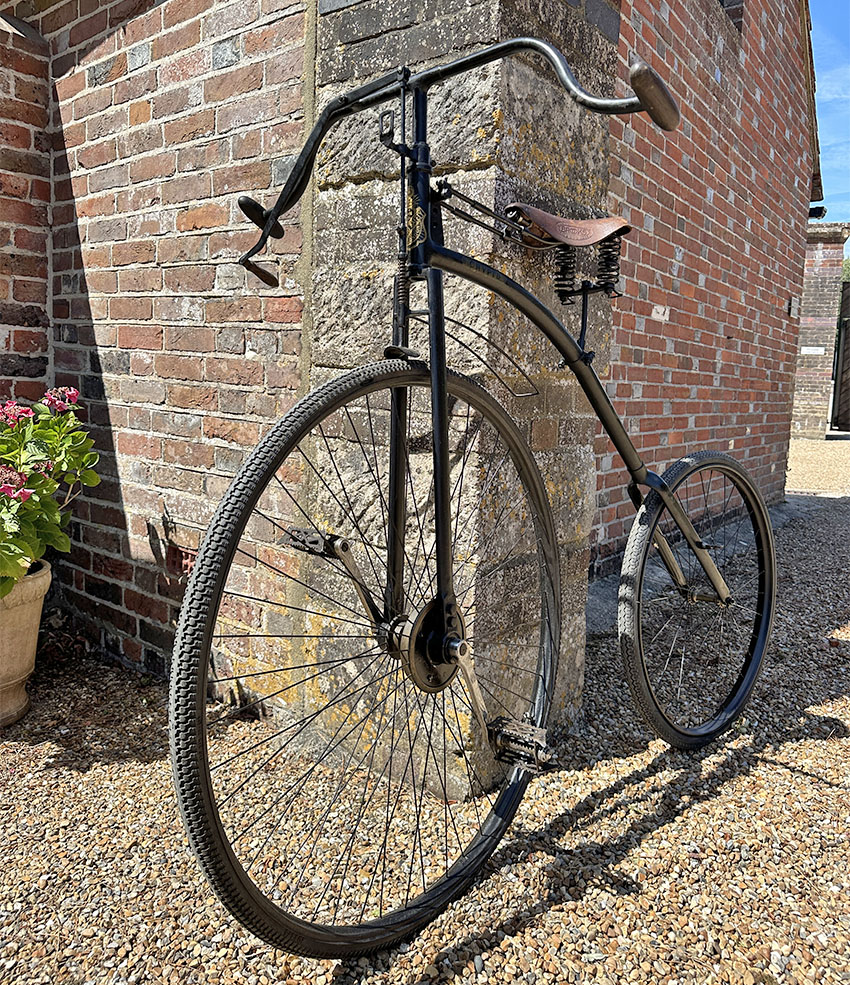
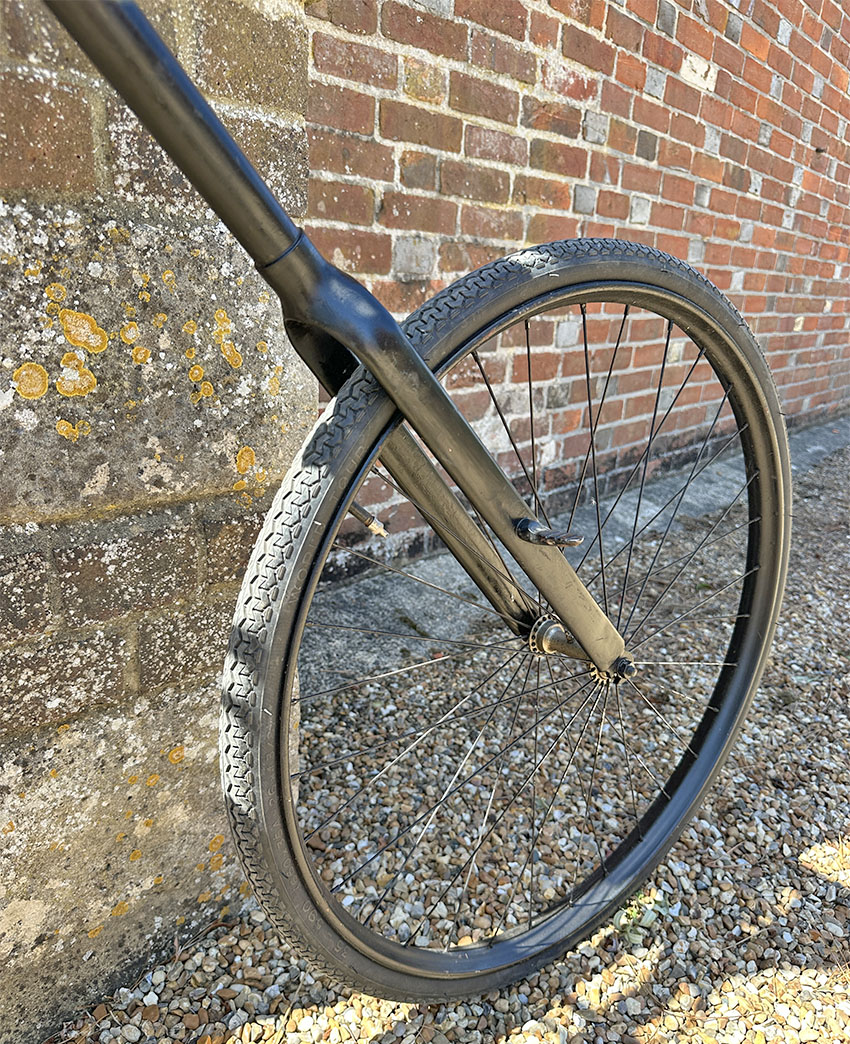
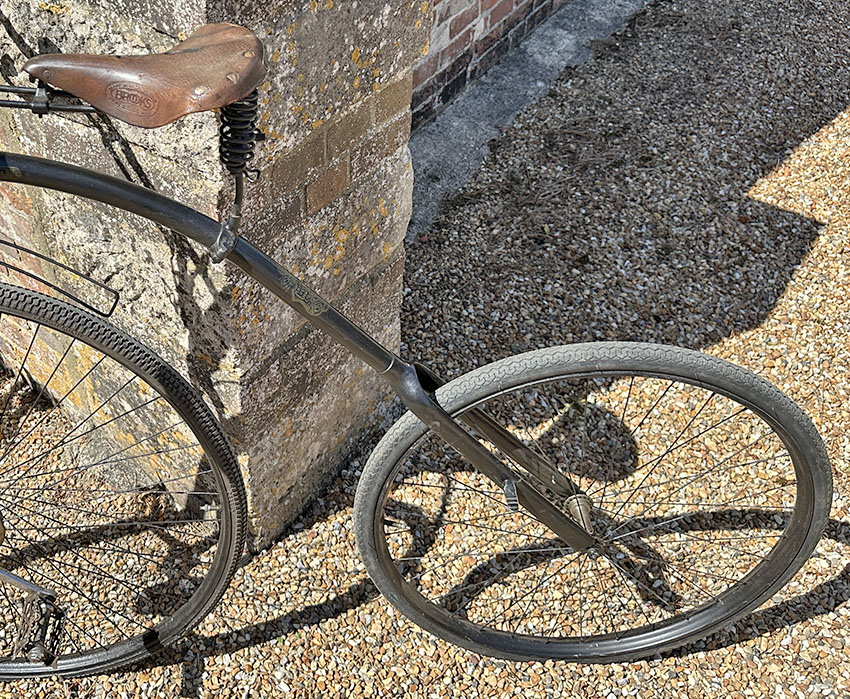
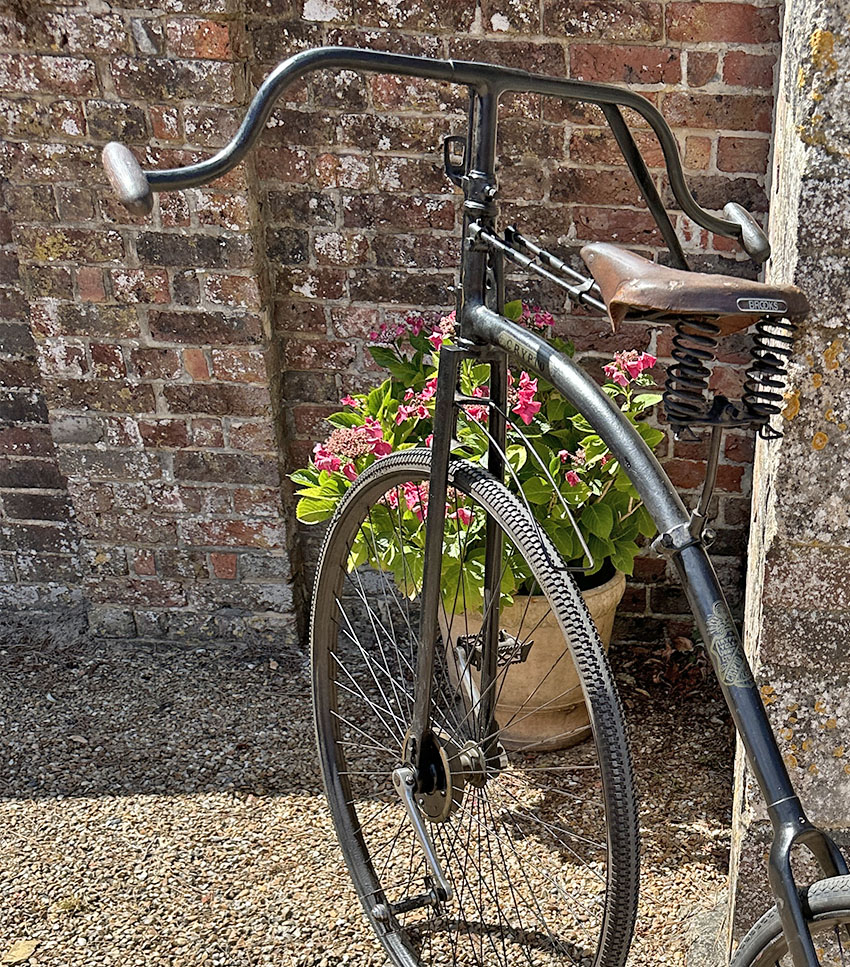
The Crypto Front Driver is a gloriously eccentric Victorian machine, built to fill a niche market during the decade when independent wheeled transport first became an essential part of society. Its ‘niche’ was as an easily mountable and usable machine for gentlemen who had by now become too old to ride the Ordinary (‘penny farthing’) bicycle that had been prevalent in the previous decade.
The Ordinary’s place was now usurped by the more practical safety bicycle. The final models of Ordinary were manufactured in 1891, though they continued to be sold for a few years after. The Crypto F.D Safety was introduced in 1893, becoming the Crypto Bantam as the result of a final sales push in 1895 and 1896.
Although enthusiasts still ride Ordinaries – and, with increasing popularity two centuries on, updated replica models are still being manufactured – the Crypto Bantam was the last front-driver to be made in the Victorian era before the original full-size Ordinary became extinct.
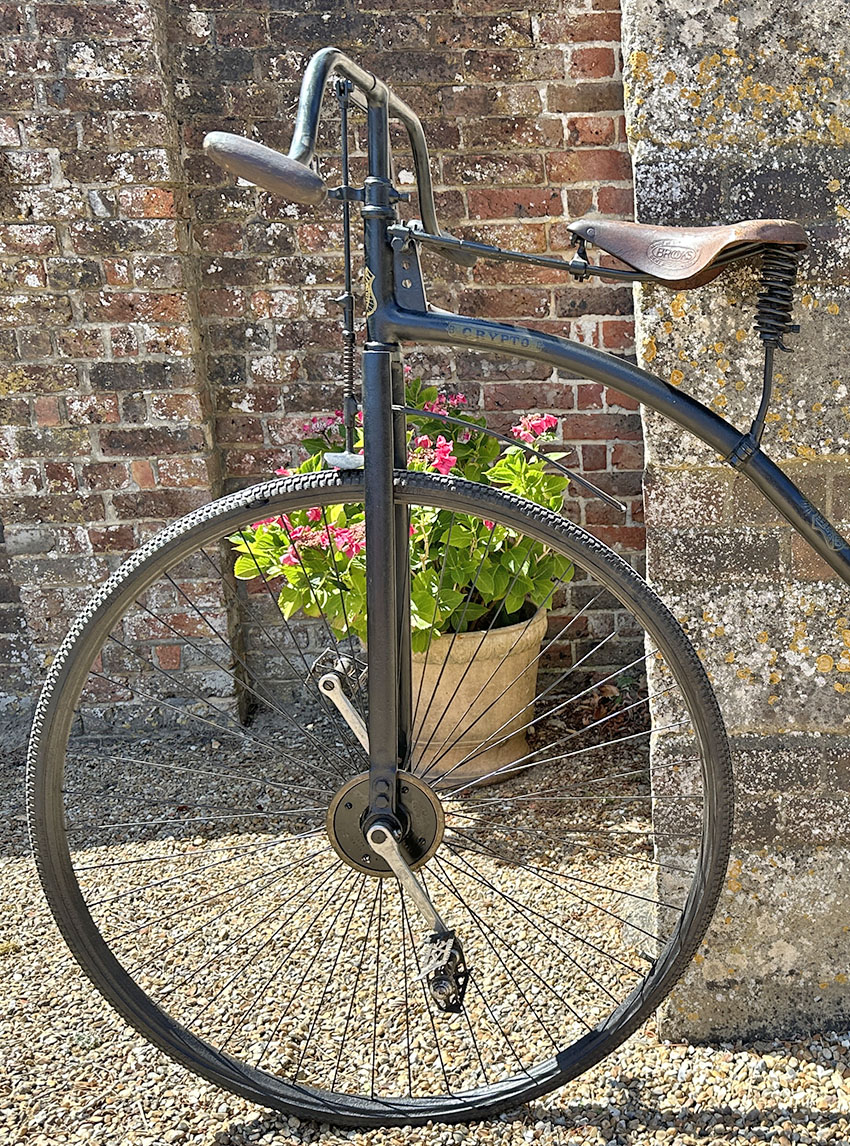
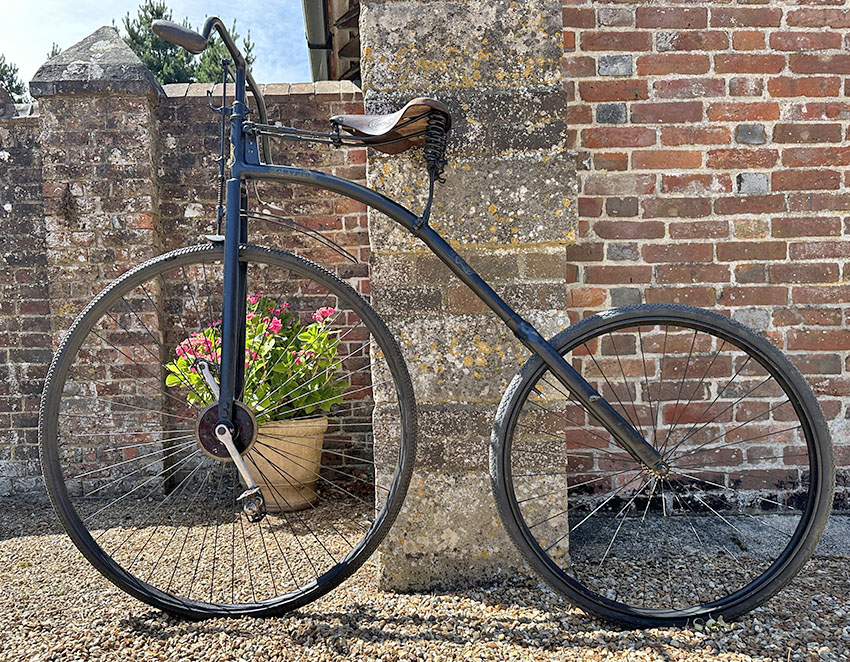
1894 Crypto ‘Bantam’ F.D Safety
32″ Front Wheel
26″ Rear Wheel
No 4136
LENGTH: 64″
WIDTH: 31″
HEIGHT: 50″
(Now sold)
The Crypto Bantam front-driving bicycle was manufactured at a time when the British cycle industry led the world. Coventry firms had started the bicycle business and motorised vehicles had not yet been introduced. In 1893 the bicycle ruled the road!
This machine was restored by Paul Knight, a very talented cycle builder. His project started when he bought the front hub , spokes and wheel rim. Everything else was missing, so he built the rest of it himself. What particularly attracted him was the large diameter front wheel of the early models – later Bantams have a small wheel which makes them rather unsteady. This 32″ front wheel is much more practical and it can be ridden at some speed.
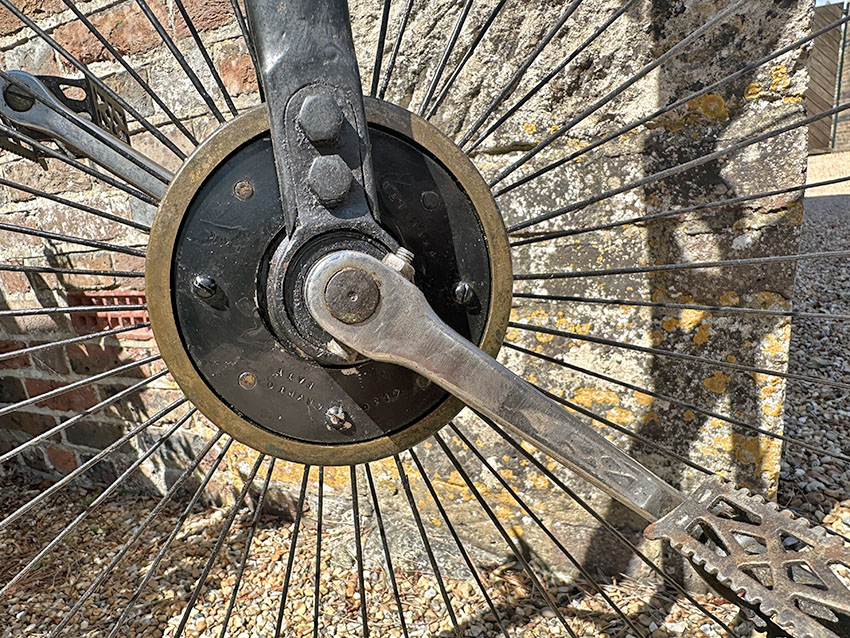
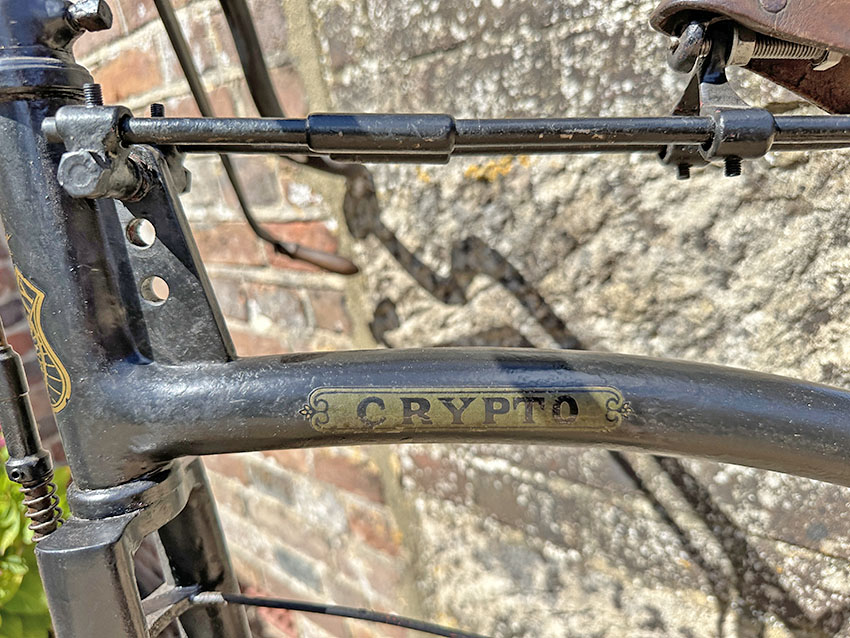
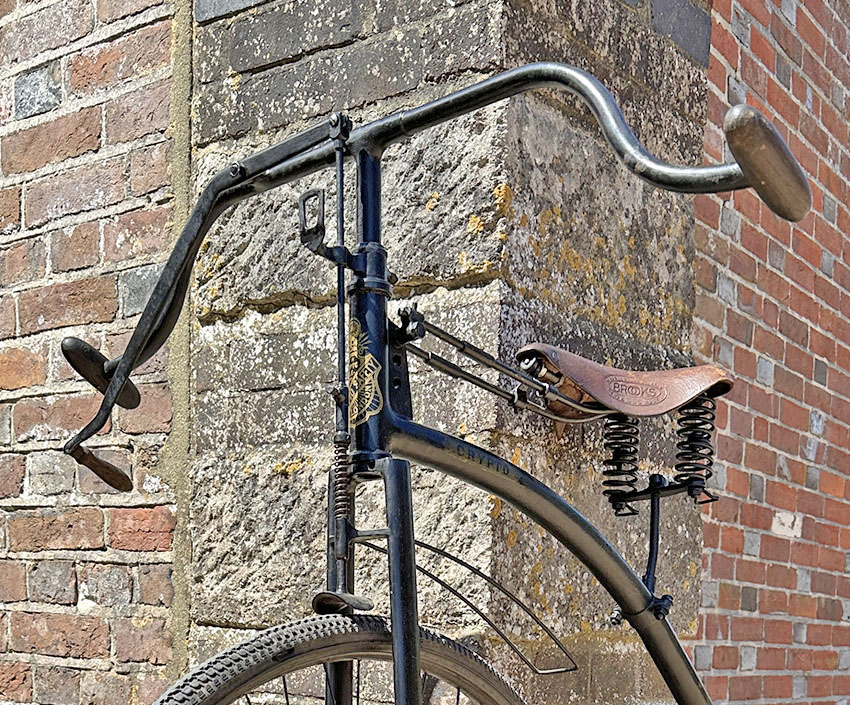
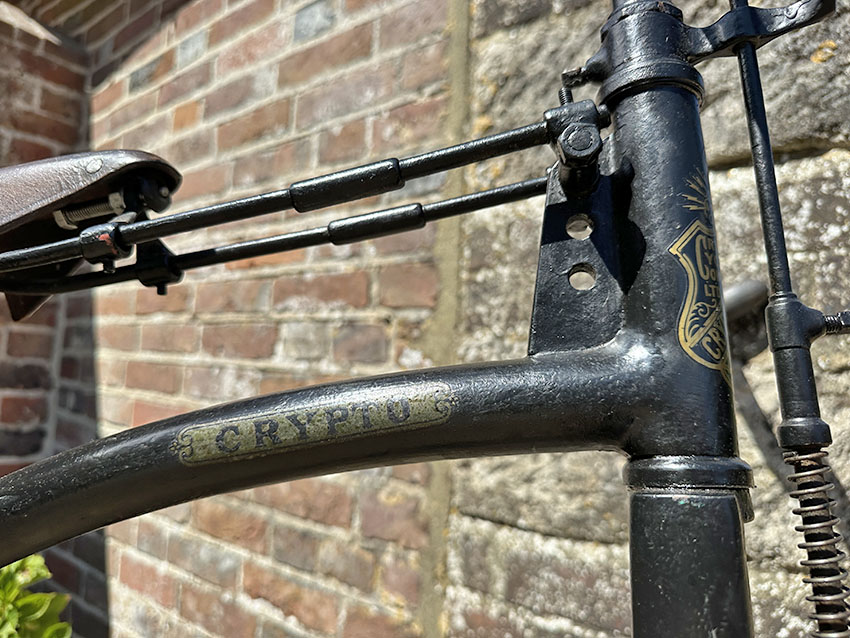
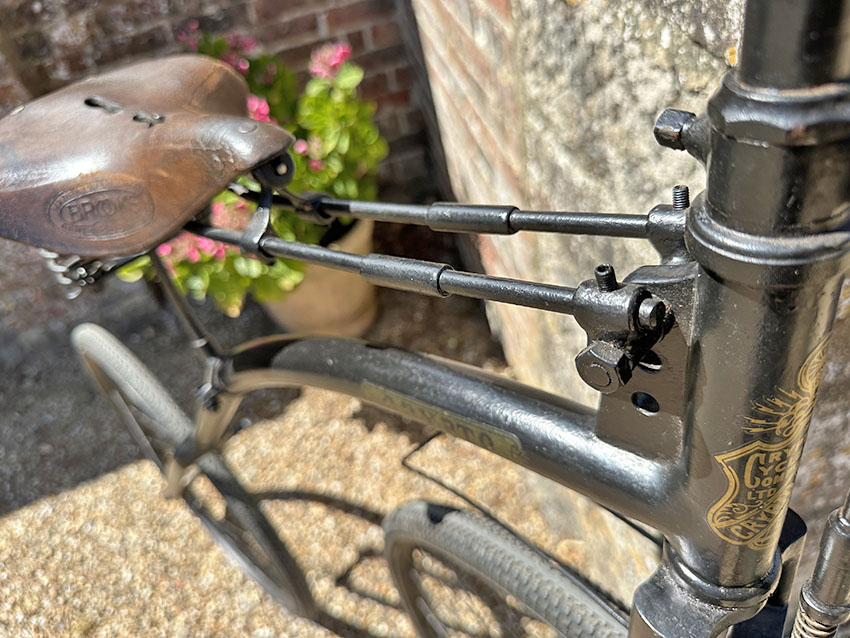
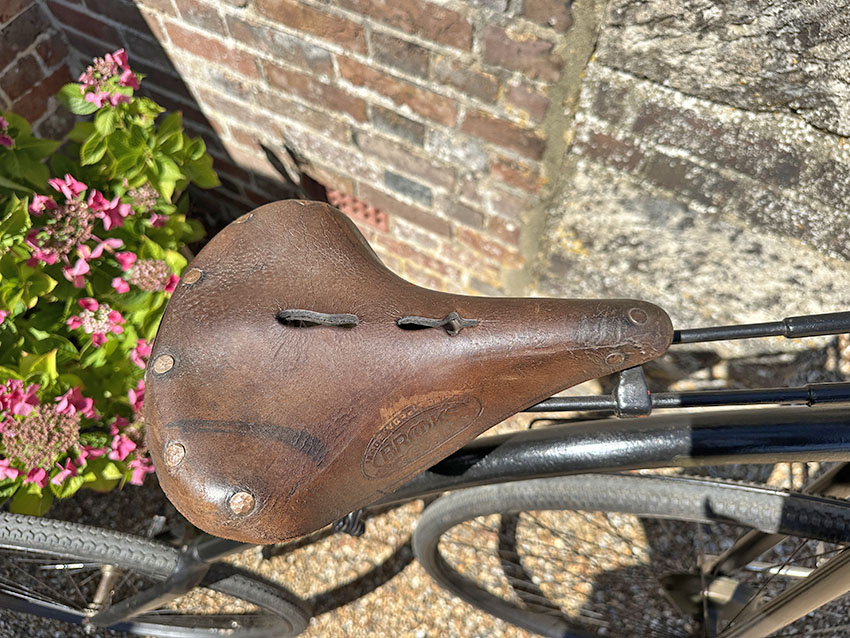
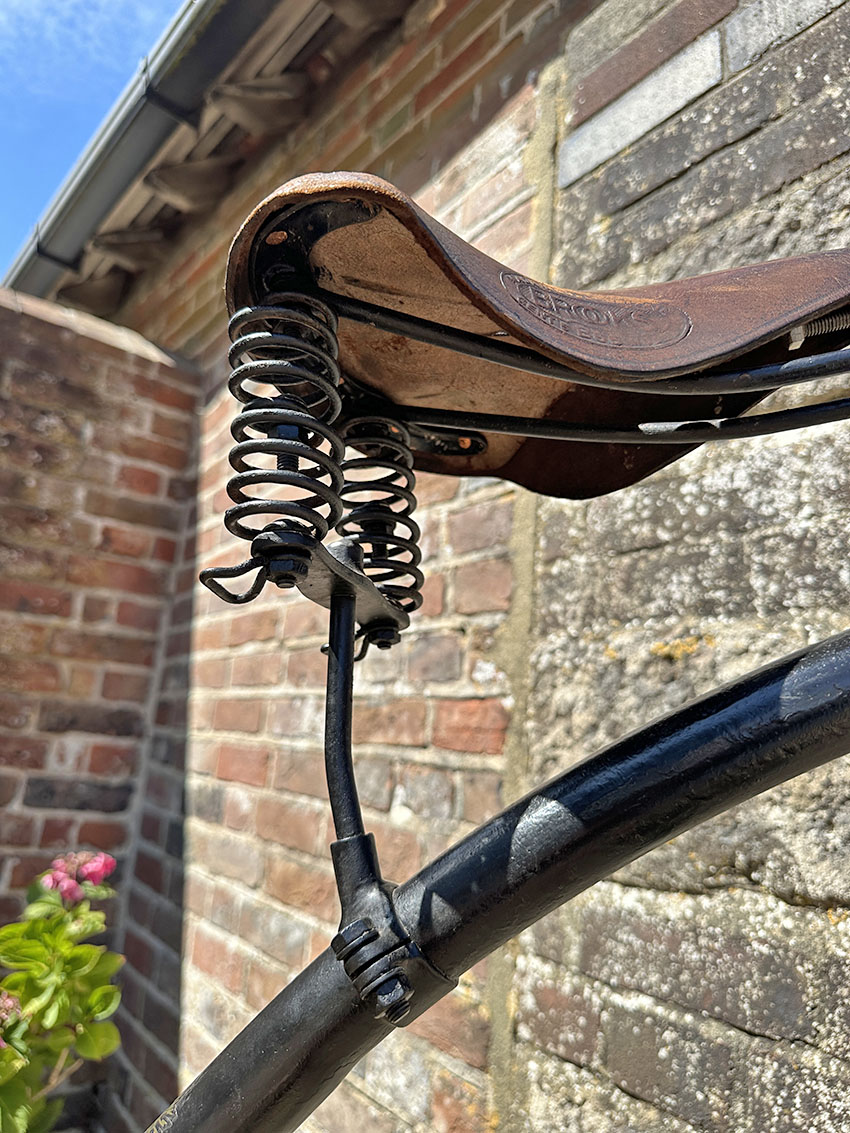
It’s in excellent condition all round, and you can view a video of Paul riding it. He is around 6ft tall and as he built the Crypto for himself the saddle is adjusted to his height. But it can be lowered by around 3 inches if required. If you look at my photos you can see that the bolt securing the front end of the saddle rod can be fitted at two lower points. And the plate under the saddle springs is secured by a nut to the seat post, to allow the seat to be raised or lowered. You can also see photos provided by Paul of the new hub internals – he was surprised to find that they were still available.
This machine is a glorious reminder of an age now passed, a time of curiosity and innovation in transportation that laid the foundations for travel in the 20th century. Front-driving bicycles stood out from the crowd in the 1890s, and over 130 years later they still command attention. This state-of-the-art machine has survived to charm bystanders and fellow travellers wherever you ride it.
UPDATE: Though Paul rode it without any issues, and Georgina also rode it when I displayed it at the Amberley show a year ago (see the other video below), when her Dad got on it, the rim collapsed! Paul has now built a new 32 inch Westwood rim for it, and it’s ready to ride again.
VIDEO of Georgina riding the 1894 CRYPTO FRONT DRIVER
VIDEO of Paul riding the 1894 CRYPTO FRONT DRIVER
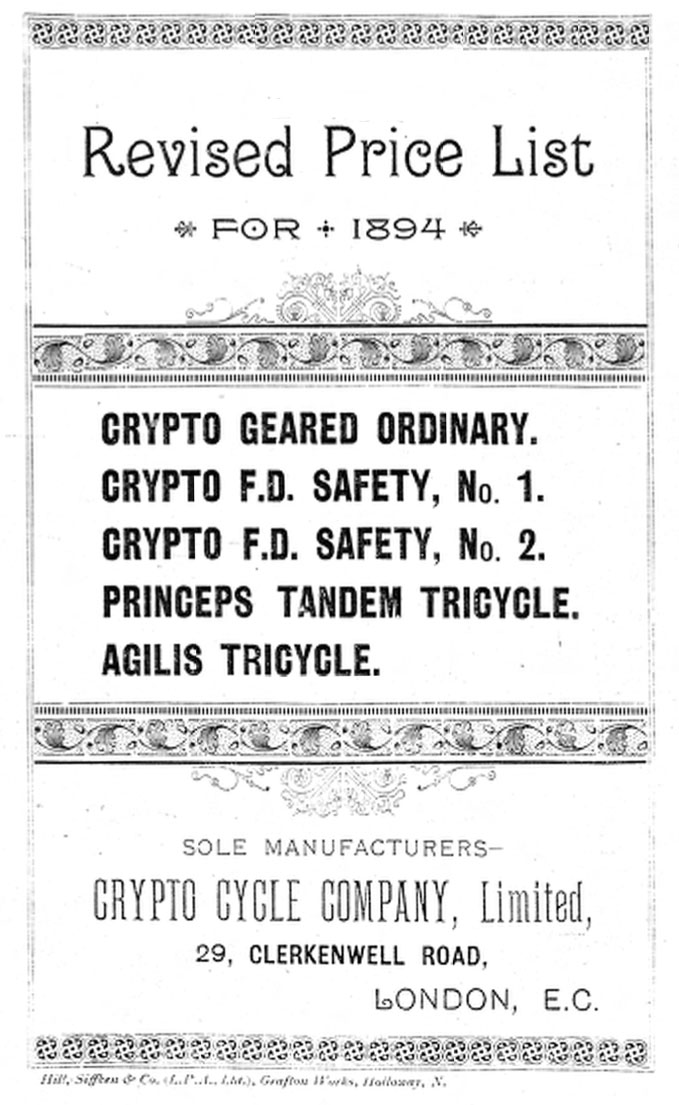
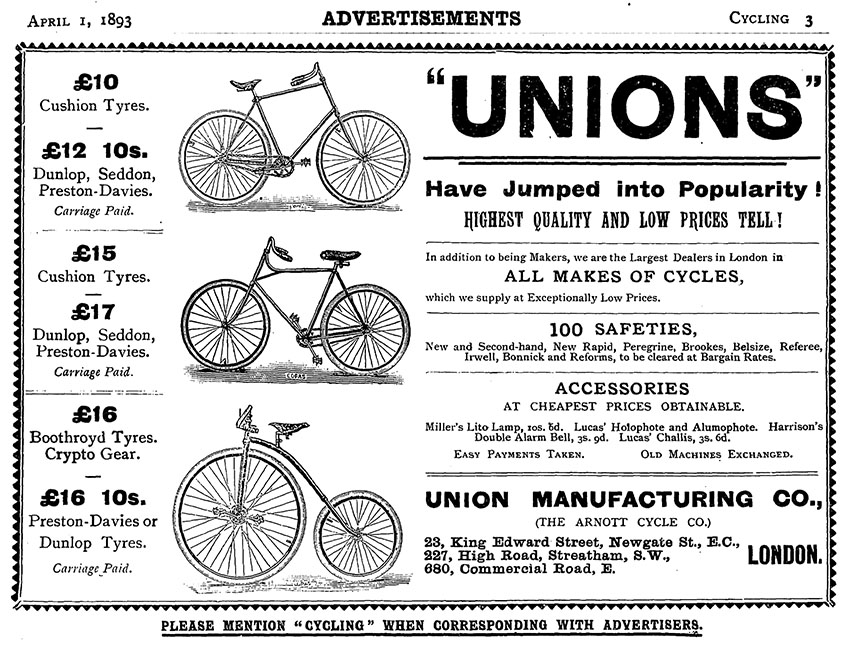
1894 CRYPTO CATALOGUE EXTRACTS
INSIDE CRYPTO GEARED HUB No 4136
CRYPTO HISTORY
The Crypto company dates from 1883 so far as the gear is concerned. The company produced the two-speed epicyclic gear designed by William Thomas Shaw and William Sydenham in 1882 (patent 1882/3230) and called it the ‘Crypto Dynamic’. The hub was also used on the ‘Xtraordinary’ by Singer & Co in 1886.
In 1887 the company started making several single and tandem tricycles of the ‘Olympia’ pattern as produced for Marriott & Cooper. The Crypto models were called ‘Agilis’, the ‘Preceps’, and the ‘Corona’. The ‘Preceps’ was convertible into the ‘Agilis’. The ‘Corona’ did not appear until 1890. It was designed for ladies and could be converted into a lady’s ‘Agilis’. Many considered the Crypto machines superior to the ‘Olympia’ as they had more weight on the driving wheel, larger wheels, a Crypto two- speed gear and increased brake power (a foot lever for the front rider and a hand lever for the steerer, although both acted on a rear wheel spoon brake). The ‘Presto’ and ‘Princess’ were also made before 1892.
In March 1888 the company was located at 73a Chiswell Street, Finsbury Square, London, but by September of that year it had works and branch showroom at 64 City Road. Subsequently it moved to 47 Farringdon Road and 29 Clerkenwell Road, London. In July 1889 the Crypto No.1 Safety with diamond frame retailed at £15 15s. From September 1891 the company was reconstructed and amalgamated with Ellis & Co. Ltd by mutual consent with the business being carried on from 131 Charing Cross Road, London, by I. W. Boothroyd (d.1938) and Arthur Sydenham, works manager. A ‘Facile’ (then pronounced to rhyme with wheel) 32in front wheel safety had been introduced at the 1891 Stanley Show as well as a ‘Farringdon’ model. There was now an improved driving gear (patent 1891/20612).
The company introduced a small wheeled geared front driver at the Stanley Show in November 1893 called the ‘Crypto F.D. Safety No.3’. The name ‘Bantam’ was given to the machine in February 1894 to promote the fact that it could be mounted without using a step. It was available with two 24in wheels geared to 66in; two 23in wheels geared to 63in; or two 22in wheels geared to 60in. A roadster with brake and mudguards weighed 28 lbs.113 The cranks drove an axle which carried a pinion. On the inner circumference of the hub was a ring of teeth. Between these teeth and the pinion was a set of three small pinions revolving on studs and fixed to the hub flange. With the pinion in use a lower gear was obtained from the otherwise direct drive.
The 1895 model reverted to the original F. D. Safety style frame. There was the ‘Bantamette’ for ladies in 1896. In that year the company name changed to Crypto Works Co. Ltd.
The ‘Alpha Bantam’ was the final attempt, introduced in the Autumn of 1897, to maintain the popularity of the front-driver against the advance of the chain-driven rear wheeled safety. It appears there were two or possibly three variations of the ‘Alpha Bantam’. At the 1900 Stanley Show a wide selection of machines were shown varying in price from £10 10s. to £21 10s. for bicyles plus Racer and Roadster tandems at £23 and £24 10s. respectively. Also in 1900 it produced rear drivers with ‘Collier’ two-speed gear and ‘Gardner-Hearson’ brake and a ‘Flexor’ spring frame. The 1907 catalogue offered six bicycles, from £6 15s to £8 15s., two tandems, two tricycles and a tandem tricycle. The company was then trading from 14 Mortimer Street, London. The company became the Crypto Car and Cycle Co. and there was a brief flirtation with motor cycles and even a car, then motor car components under the leadership of W. G. James. Having started in 1898 to make an electric food mincing machine, and then a food mixing machine, using the epicyclic gear, eventually the company became Crypto Peerless, part of the Electrolux group.
OTHER MAKERS’ GEARED FRONT DRIVERS
Some other companies purchased licenses to use the Crypto geared drive in their machines, including Singer, who made the carrier tricycle illustrated in their catalogue below.
ORDER FORM TO HIRE A CRYPTO
History of Crypto Bantam text with thanks to: An Encyclopaedia of Cycle Manufacturers: The Early Years up to 1918 (Second Edition), Compiled by Ray Miller