
c1908 BSA Fittings Machine
Heavy Duty Roadster
26″ Frame with double top tube
28″ Wheels
New Departure Coaster Brake
Webley & Scott Fencing Musket
and replica rifle clips, Lucas Cycloe front carrier rack & toolbag.
Brooks saddle
(Now sold)

This is a BSA Fittings Machine, ie it was assembled from parts, or fittings, purchased through the cycle trade. Cycle shops throughout the country built bicycles to customers’ individual requirements and, by buying BSA fittings, they were able to sell the finished bicycle at a much cheaper price – usually around 50% of the cost of a machine of similar high quality made by one of the top manufacturers.
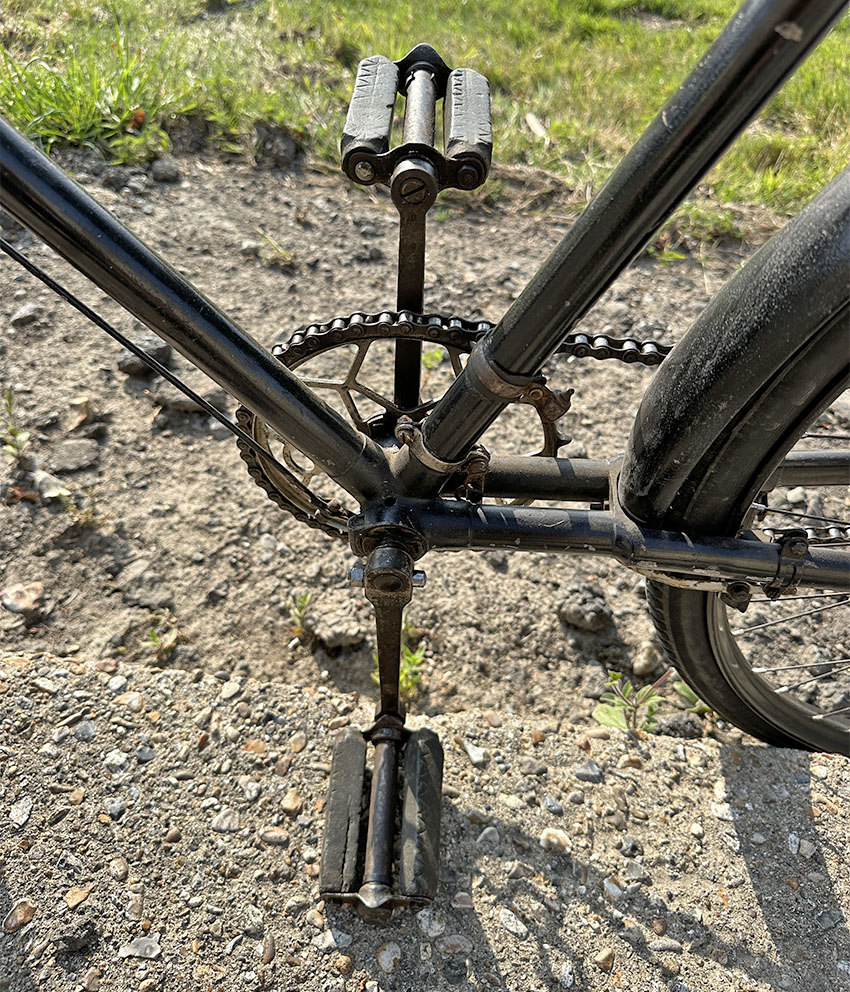
This BSA has two rear brakes. As well as a standard BSA rear brake, it also has a New Departure coaster brake. This chainwheel design was introduced in 1908. The front fork is a much earlier pattern, used around the turn of the century. This was the point of buying fittings: you could save money by using slightly out-of-date parts and, of course, because they were all made by BSA they were absolutely top quality even if they were older than the current stock.
This machine was most likely not built as a military bicycle. But when war broke out in 1914, the government did not have a supply of military bicycles. They did not even have enough rifles and uniforms! Though the government did order bicycles from the manufacturers, the overwhelming majority of bicycles used in the war were ordered directly from the manufacturers by the men themselves or by the relevant cyclist battalion if it had funds available. Often cycle purchases were provided by local industrial groups. Many soldiers in the Cyclist Corps used their own personal bicycles.
Military cycle equipment generally included a carrier rack (front, rear or both), rifle clips and toolbag. Because of a shortage of rifles, soldiers who were sent overseas were prioritized, and those who enlisted subsequently often had to train with older rifles, air rifles, or in this case, a Webley & Scott Fencing Musket, which resembled a rifle but, as the name implies, was used for bayonet practice.
The rifle is not included in the sale of this bicycle. The BSA is a double top tube version with a 26 inch frame and 28 inch wheels, introduced by the company in 1900 as their ‘Heavy Duty Roadster.’ It’s in excellent original condition and is ready to ride.


c1910 BSA CATALOGUE EXTRACTS




WEBLEY & SCOTT FENCING MUSKET


Webley & Scott is best known for the standard issue service pistol used by the armed forces of Great Britain and its Empire from 1887 onwards. Officially known as ‘Pistol, Webley, Mk 1’ the initial contract was for 10,000 .455 calibre revolvers. It went through various model changes. The Mk IV was known as the ‘Boer War Model’ and the Mk VI was introduced in 1915, to be used for the duration of WW1. The company also manufactured flare pistols and a bayonet training rifle (fencing musket).
The Bayonet Training Rifle is constructed like a rifle with wood stock and cup steel butt plate. The action and barrel are just a tube, with wooden fore stock, containing a large coil spring into which a floating steel rod is secured with a steel disc to the front. Upon contact with an opponent the rod compresses into the tube simulating bayonet combat, which, at that stage of WW1 was an everyday event on the Western Front.


