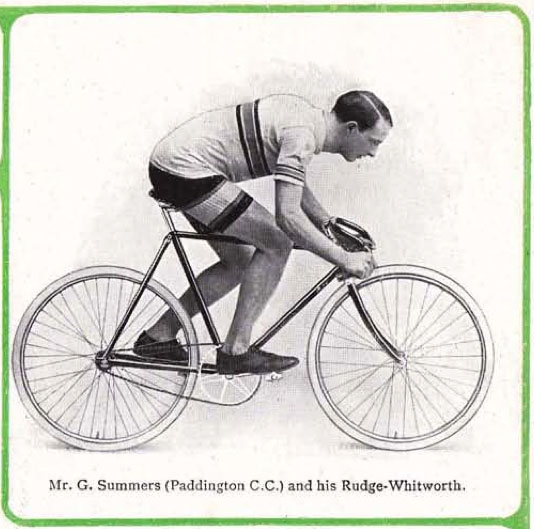
“This celebrated racing bicycle – the latest product of years of unrivalled experience in the construction of speed cycles – has maintained and improved its great reputation wherever English bicycles are ridden on the racing track.
No other racer combines such rigidity and strength with such light weight, and racing men find it surpasses all others in its quick response to the effort or ‘jump’ of the rider.”
The track machine featured here can be seen below when it won for the Dunlop Cycle team at the Herne Hill Centenary re-enactment in 1988.


1910 Rudge-Whitworth ‘No 4 Aero Special’ Path Racer
Narrow Section Sloping Top Tube (Standover height: 32.5″ to 30.5″ = 2″ Drop)
Green Enamel Paintwork
23″ Flush-Joint Frame
No 74 Handlebars with green celluloid grips
Rat trap pedals with toe clips
Rudge-Whitworth celluloid inflator pump
Toolbag with Rudge-Whitworth spanner and oilcan
Challis bell
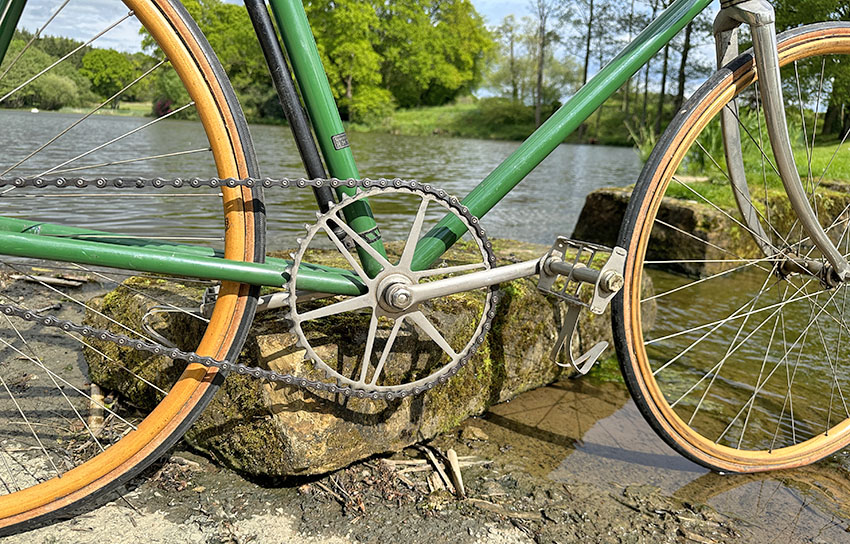
26 x 1 1/4″ Fairbanks Sprint Wheelset with Tubular tyres
(Now sold)

My friend Mike owned this racing machine for 50 years, but has now decided to scale down his vintage bicycle collection. It was restored in the 1970s and is still in superb condition all round. Mike rode it in the 2003 Randonnee du Centenaire before the last stage of the Tour de France.
It was also used to secure the necessary win for the Dunlop Cycle team at the Herne Hill Centenary re-enactment in 1988. There is a photograph of this centenary that accompanies the machine, plus the Dunlop jersey specially commissioned for the event.
This historic racing machine is a fast and practical fixed wheel lightweight for modern riding, and is suitable for any vintage racing events. It’s ready to ride.



1909 RUDGE-WHITWORTH CATALOGUE


FAIRBANKS WOODEN SPRINT RIMS

HISTORY: The wooden bicycle wheel was introduced by A.C Fairbanks, with patents 1893-1897. He was an American banjo maker, and the rim was actually a variation of the wooden rim used inside a banjo’s metal outer casing. You can see it here on the inside of my 1886 Fairbanks & Cole banjo.
A.C Fairbanks set up a cycle company ‘Fairbanks, Sanford & Cole’ in 1890, also becoming the East Coast agent for the British manufacturer John Marston to sell Sunbeam bicycles in the USA. Fairbanks subsequently sold his banjo business to focus on marketing his wooden rims.

BRITAIN: With backing raised by Harry Lawson and Ernest Hooley, Fairbanks Wood Rim Co also established a British factory. This was at Draycott Mills in Derbyshire, where the Simpson Lever Chain & Cycle Co was located.
SCANDAL: The market values of these and other cycle companies were vastly inflated and floated on the stock exchange in an enterprise created by Lawson and Hooley. Other companies drawn into the scheme included Dunlop, Raleigh, Swift, Humber, Clement-Gladiator, Singer, Schweppes, Bovril, The Great Horseless Carriage Co and Trafford Park Estates (Hooley created the world’s first industrial park there). However, the ‘cycle boom’ of the early to mid 1890s then started to slump and share prices collapsed. Many companies were liquidated. Frank Bowden of Raleigh Cycle Co was one of many investors who lost money by backing Fairbanks Wood Rim Co, badly affecting Raleigh cycle output.


TOOLBAG + RUDGE WHITWORTH SPANNER & OILER


