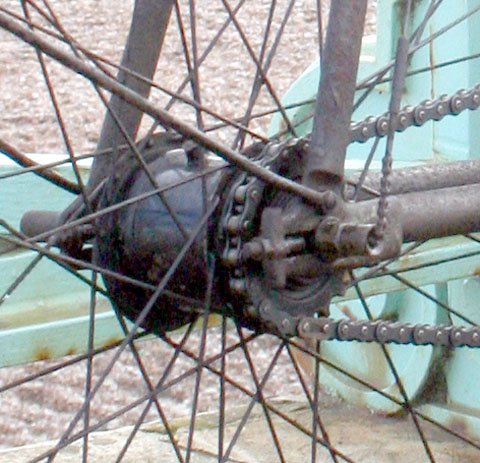
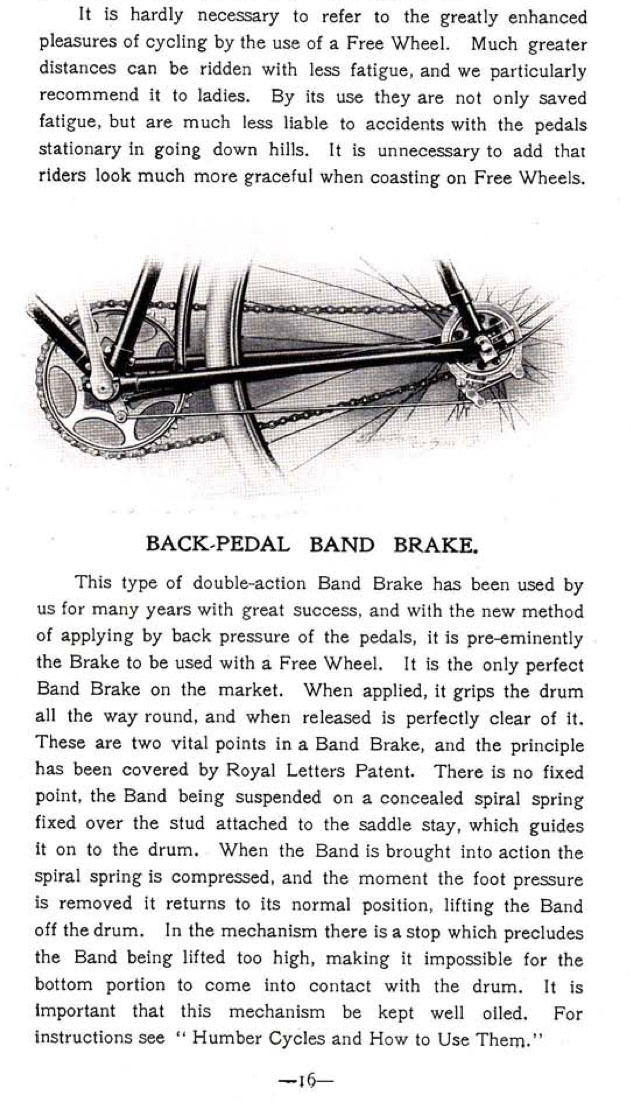
THE VILLIERS FREE-WHEEL HUB
John Marston’s Sunbeam bicycles had an excellent reputation, which meant that he needed top quality components. The pedals he was using in 1898 were not good enough, so he sent his son Charles to America to find a better supplier. Charles brought home patterns of new pedals from Pratt & Whitney of Connecticut, and they ordered the equipment to make them. When the machinery arrived it was found to be too big for the factory, so John bought Edward Bullivant’s engineering firm at 5 Villiers Street, moved the machinery in and Charles was put in charge of the firm. They named it the Villiers Cycle Components Co.
Their production soon exceeded Sunbeam’s requirements, so they asked Frank H. Farrer, manager of the Coventry branch of Palmer Tyre Co to sell Villiers pedals for them. As a result, he started his own wholesale business supplying cycle parts to the trade. At the time Villiers made the best pedals and soon most of the cycle makers were using them.
In 1902 Farrer sold his business and came to work for Villiers, who now had a workforce of 30. In the same year the Villiers freewheel was developed and Villiers decided to produce their own lightweight version. Around this time John Marston sold Villiers to his son Charles for £6,000, the value of the company’s machinery. The new freewheels were so successful that pedal production ceased and Villiers concentrated on freewheel production alone. In due course, income from freewheels allowed Villiers to explore geared hubs, the first being the Villiers 2-speed. Their claim that a 3-speed had too many components and that the low gear was unnecessary was also used by Sunbeam for their 2-speed epicyclic gear.
Humber offered the Villiers 2-speed gear as an option for Beeston models in their 1905 catalogue. Of course, Sturmey-Archer was meanwhile developing their 3-speed gear, which soon took over the market.
TO SEE THE
1905 HUMBER TRUSSFRAME with VILLIERS 2 SPEED
PLEASE CLICK HERE


1901 ROYAL SUNBEAM LADIES: FREEWHEEL HUB

1903 SUNBEAM ‘ROYAL FB’ GENTS ROADSTER: FREEWHEEL HUB

1906 JAMES GENTS with 2-SPEED BOTTOM BRACKET:
VILLIERS FREEWHEEL HUB


EADIE COASTER REAR HUB
BSA amalgamated with Eadie Manufacturing Co in 1907. Eadie Coaster hubs were then offered in the BSA catalogue as an option to BSA hubs (see 1910 catalogue, below). These fitments, together with the B.S.A. Three-speed Hub, B.S.A. Chains, and B.S.A. Free Wheels, gave the Company by far the largest range of coasters, variable gears, free wheels, etc., possessed by any company.


1904-1907 BSA FITTINGS BICYCLE:
EADIE COASTER REAR HUB

1904-1907 BSA FITTINGS BICYCLE
PLEASE CLICK HERE
1910 BSA JUNIOR BICYCLE:
EADIE COASTER REAR HUB

1910 BSA JUNIOR BICYCLE
BSA THREE-SPEED HUB
By 1907 BSA were desperate to produce a three-speed hub gear. They had merged with Eadie, makers of the Fagan two-speed and a two-speed coaster brake, early in 1907. Towards the end of that year they acquired the rights of the Hub Two-Speed Gear Company. BSA therefore had the rights to produce no less than three two-speed hubs: the Fagan (Eadie), the Hub and their own Mark II hub. In addition, they had the rights to the Eadie Two-Speed coaster. But demand for two-speeds was now much reduced, whereas the market for three-speeds was almost insatiable. The Hub Company had patented a three-speed in 1903 (#22,306) but nothing commercial seems to have come of it. BSA therefore approached the Three-Speed Gear Syndicate requesting permission to build the Sturmey-Archer three-speed under license. According to Henry Sturmey, writing in 1924, the Syndicate were unable to cope with demand in 1907 and therefore granted a license to BSA.
– The Sturmey-Archer Story by Tony Hadland
The Fagan two-speed hub had been introduced at the 1903 Stanley Show for the 1904 season, and fitted as standard on the Royal Enfield Modele Riche, while a coaster brake was fitted to the ‘Royal Enfield’ and ‘Model B.’ BSA at this time only sold components, not complete bicycles, but their order books were full, and their bikes in knock-down form were in much demand from abroad, particularly Australia. Motorcycle builders favoured BSA bicycles, in particular their spring-frame models. BSA were about to expand their business: with the success of the motorcycle market, by 1910 they had also re-commenced full-scale cycle production. This was why it was essential for them to be able to fully control the supply of three-speed hubs.
1920 BSA MODEL 14D GENT’S ALL-WEATHER BICYCLE:
BSA THREE-SPEED HUB

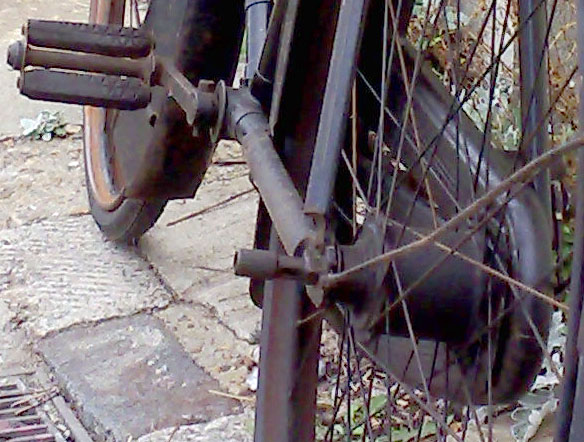
1920 BSA MODEL 14D GENT’S ALL-WEATHER BICYCLE
PLEASE CLICK HERE
1909 NEW HUDSON TOURIST:
ARMSTRONG TRIPLEX THREE-SPEED GEAR

Of particular interest is the bike’s Armstrong Triplex 3-Speed gear.


ARMSTRONG TRIPLEX 3-SPEED Co LTD
Armstrong Works, Icknield St, Birmingham

Sturmey Archer had not yet dominated the market in the early years of the 20th century, and there was considerable competition for 3-Speed gears. Armstrong was a major player in the field.
William Reilly invented the Tricoaster three-speed hub for Raleigh. Harry Reilly (William’s brother) set up Armstrong-Triplex Three-Speed Gear Co in 1906, using one of William’s discarded hub designs. Armstrong was Harry’s father-in-law. This caused a rift with the Bowdens of Raleigh, and William Reilly resigned from Raleigh in 1910.
New Hudson favoured the Armstrong gear. Armstrong Triplex was incorporated as a limited company in 1907, with their headquarters the St. George’s Engineering factory. When St. George’s Engineering’s New Rapid Cycle Co got into financial difficulties, New Rapid was taken over by New Hudson.
In 1914 Raleigh bought the Armstrong-Triplex Three Speed Co from New Hudson for £6000.


1909 NEW HUDSON TOURIST
PLEASE CLICK HERE
1909 RUDGE LADIES CRESCENT:
RUDGE WHITWORTH FREE WHEEL CLUTCH


1909 RUDGE LADIES CRESCENT
PLEASE CLICK HERE
1911 DURSLEY PEDERSEN CANTILEVER 3-SPEED No 4 GENTS:
DURSLEY PEDERSEN THREE-SPEAD GEAR


PLEASE CLICK HERE
1903 BICYCLETTE TERROT de DAME MODELE No. 1:
NEW PREFERENCE COASTER BRAKE